I was honored to deliver the Wing Foundation Lecture on the History of the Book at the Newberry Library on March 3, 2022. The event took place in person after two years of virtual events. I’m grateful to Jill Gage, Custodian of the John M. Wing Foundation on the History of Printing, for the invitation to speak about some new ideas around my next book project, “Accidental Shakespeare,” and to the staff at the Newberry for supporting this program.
Read moreCALL FOR PROPOSALS: Cambridge Elements in Shakespeare and Text
Along with my co-editor Rory Loughnane (University of Kent), I am delighted to invite proposals for Cambridge Elements in Shakespeare and Text, a brand new series of short books about the textual histories, present, and futures of the Shakespearean text.
We are interested in work that thinks in new ways about textual matters around Shakespeare and stretches the boundaries of what might be considered “a Shakespearean text.” We especially welcome proposals from early career scholars and those with something to say about textual matters around Shakespeare from the vantage of fields outside book history.
Read moreSHAKESPEARE / TEXT: Contemporary Readings in Textual Studies, Editing, & Performance
One of the great highlights of the difficult last few years was editing Shakespeare / Text, a collection of twenty agenda-setting essays about the study and use of the Shakespearean text over time and in our time. The collection was published in 2021 by Bloomsbury under The Arden Shakespeare imprint. It is part of a new series called Arden Shakespeare Intersections, general edited by Sonia Massai, Farah Karim-Cooper, Lucy Munro, and Gordon McMullan.
Written by 21 leading experts on textual matters, each chapter challenges a single entrenched binary—such as book/theater, source/adaptation, text/paratext, canon/apocrypha, sense/nonsense, extant/ephemeral, material/digital and original/copy—that has come to both define and limit the way we read, analyze, teach, perform, and edit Shakespeare today.
Read more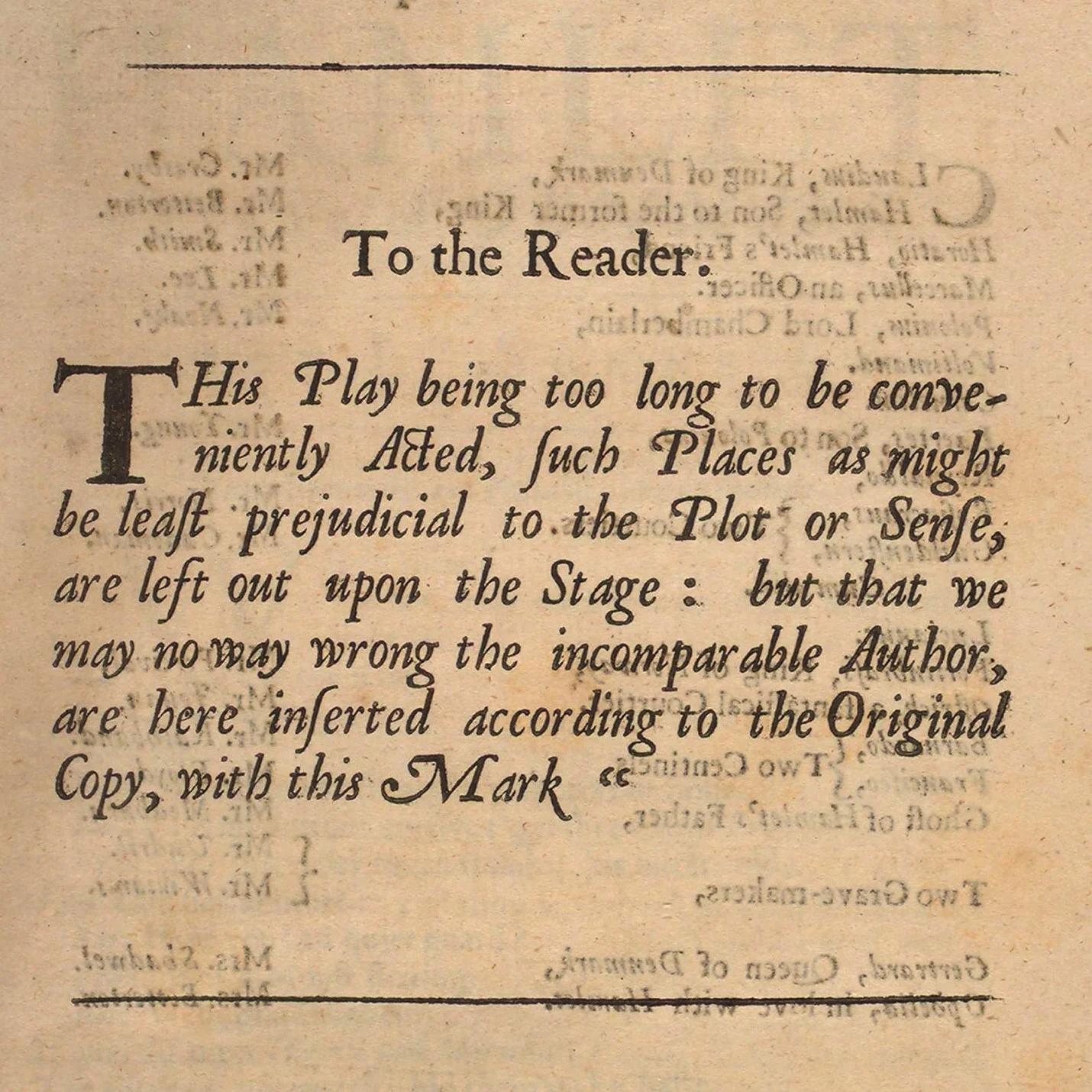
Last year, I started reserving a day in each of my Shakespeare courses for students to "make" quartos. I wrote at some length (almost exactly a year ago) about the experience of making Q1 Hamlet with my students at VCU and posted instructions, information about supplies for the activity, and a link to the sheets (which I made from EEBO printouts).
This semester, I'm teaching a senior seminar called "Early Modern Drama: Manuscript, Print, Performance" that focuses on the material-textual processes that facilitated the making of theatrical performance and printed texts of the plays. So far, my students have reverse-engineered scribal backstage plots of Doctor Faustus, performed a scene from the same play using cue scripts, and "made" quartos.